| Brief Description |
In 1929, Amrita Sher-Gil joined the Ecole des Beaux Arts in
Paris, and developed therein a visual language characteristic of
'Western' sensibilities, with its naturalism and textured
application of paint.
By the mid 1930's, Sher-Gil's style of painting underwent a
radical change where the colours, textures, vibrancy and the
earthiness of the people had a deep impact on the young artist.
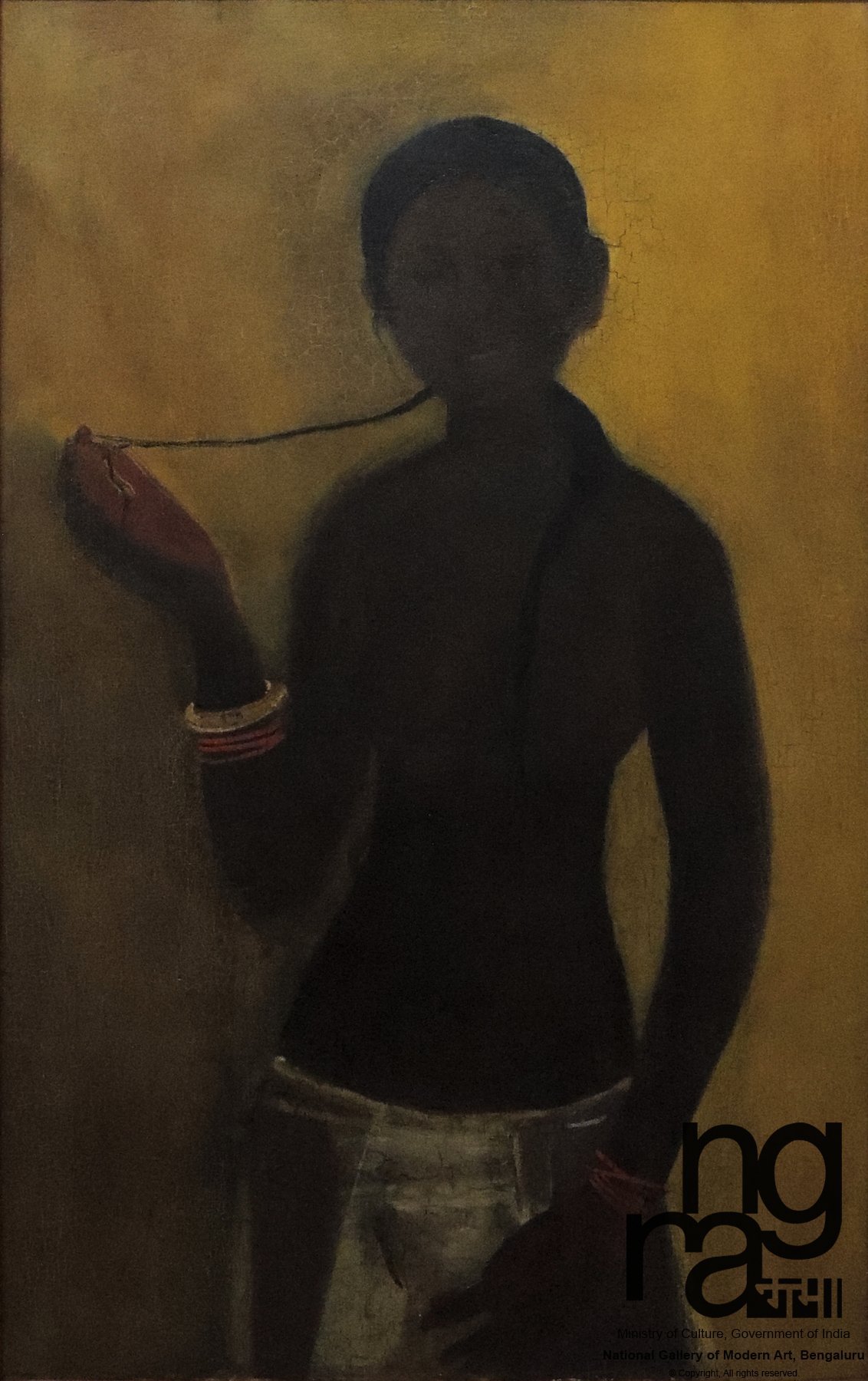
In this painting we see a young girl standing,
holding her plaited hair in her right hand. her body posture, and
her smiling face that looks at the viewer suggest her playful
demeanour. Her waist is covered with a
white skirt while she is in the nude from waist above. The
artist's fascination seems to be focused on the young girl's
simplicity of clothes and jewelry, reflective of her 'village'
background. The "Indian body" is also given attention by Sher-
Gil, wherein she emphasizes on the young girl's long slender
waist, and arms.
It is evident that Sher-Gil's transformation of
style is complete by this period, and the focus is now not so
much on realistic portrayal, but thematic and colour scheme. As
Geeta Kapur has written, Amrita Sher-Gil had to 'act out the
paradox of the oriental subject in the body of a woman designated
as Eurasian - a hybrid body of unusual beauty'. |